

Blog & Articles
Bathroom Insights & Guides
Expert advice, design inspiration, and comprehensive buying guides for luxury bath spaces.
How to Choose a Wall Hung Toilet Commode?
Table of Contents
- Define Your Wall-Hung Toilet Space and Installation Requirements
- Compare Toilet Frame Types, Weight Ratings, and Mounting Systems
- Select the Bowl Shape, Size, Height, and User Comfort Features
- Evaluate Flush Performance, Water Use, and Cleaning Design
- Check Compatibility, Maintenance Access, and Total Installation Cost
- FAQS
- Conclusion
- Related Posts
Choosing a Wall Hung Toilet Commode is more than selecting a sleek bathroom fixture. It changes how the room uses space, weight, and plumbing.
Market research supports this shift. Grand View Research identifies growing demand for smart and space-saving toilet systems. Fortune Business Insights also reports rising interest in premium bathroom products and water-efficient technologies. These reports show direction, not a complete buying answer. They rarely reveal the practical details behind the wall.
Richard Trethewey, a respected plumbing expert and television educator, has said, “A good bathroom starts with access to the plumbing.” That principle matters here. A concealed carrier frame must support the bowl securely. The service opening should remain reachable. A careless installation can turn a clean bathroom into a costly repair project.
Picture the finished room. The floor continues beneath the bowl. Cleaning becomes easier. The flush plate sits neatly above the concealed cistern. However, the wall must be strong enough, and the frame must match local installation requirements. Check those details before admiring the appearance.
Real experience also brings uncertainty. Product claims can sound impressive. Yet flushing performance, seat comfort, spare parts, and installer skill vary widely. Some models save space but demand deeper wall preparation. Others offer excellent design but limited after-sales support.
This guide examines those trade-offs clearly. It compares structure, flushing systems, dimensions, maintenance access, water use, and installation costs. The best Wall Hung Toilet Commode is not always the most expensive one. It is the model that fits your wall, habits, budget, and long-term maintenance expectations.
Define Your Wall-Hung Toilet Space and Installation Requirements
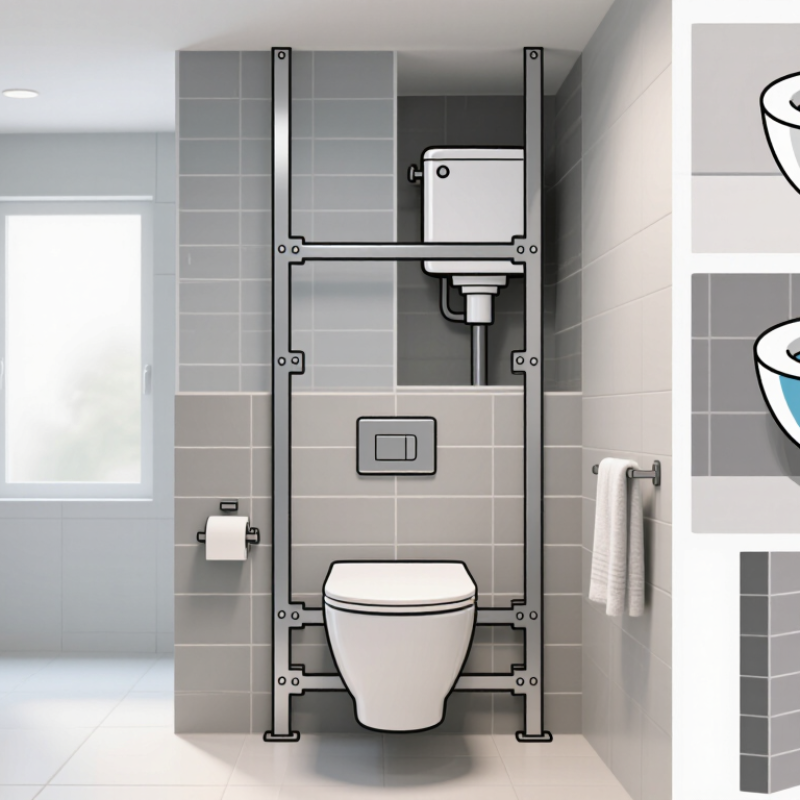
Before choosing a wall-hung toilet, measure the bathroom carefully. Note the wall width, finished floor-to-wall distance, and space from the bowl to nearby fixtures. Mark the door’s swing with tape; an open door can make a comfortable layout feel cramped. Small details matter. Also check where the waste pipe and water supply enter the room. Their positions may limit where the toilet can go or increase installation work.
A wall-hung toilet needs a concealed support frame, often called a carrier, inside or against the wall. Confirm that the chosen wall construction and floor can accommodate the frame, and ask a qualified installer to assess the structure. Check the required drainage connection, water inlet, and frame dimensions against the product’s installation documents before closing the wall. Guessing here is costly. Leave a suitable access route for servicing the cistern, usually through the flush plate, and make sure the finished wall thickness matches the frame specifications.
Decide the seat height with the people who will use it, then measure from the planned finished floor, not the bare subfloor. Allow room for cleaning around the bowl and for knees in front. Measurements can still be off by a little, especially in older rooms with uneven walls. Recheck them on site before purchasing the frame or cutting pipework.
Compare Toilet Frame Types, Weight Ratings, and Mounting Systems
How to Choose a Wall Hung Toilet Commode?
A wall-hung toilet depends on its concealed frame, not the ceramic bowl alone. I once assumed every frame worked with every wall, but that mistake can create costly changes. Floor-supported frames transfer most load to the finished floor. They suit masonry walls and many renovation projects. Wall-supported frames rely more heavily on structural studs or reinforced masonry. Adjustable universal frames can help when floor height or wall depth is unusual.
Check the tested weight rating carefully. It should cover the user, the seat, and movement during use. A 400-pound rating does not mean every surrounding wall can support 400 pounds. The floor, studs, bolts, and backing must work together. Look for documented testing, clear installation instructions, and load information from qualified manufacturers. Ratings can be misunderstood.
Mounting systems also affect stability and maintenance. For a stud wall, add solid timber or steel reinforcement at the fixing points. Masonry installations need suitable anchors and accurate drilling. Measure the frame depth before closing the wall; a few lost centimeters can affect the flush pipe and service opening. Keep access to the cistern. Small details matter. I would also inspect the finished floor level twice, because a minor error can make the bowl feel uncomfortable or appear uneven.
How to Choose a Wall-Hung Toilet Commode?
Comparing frame types, typical installation depth, weight ratings, and mounting systems
How to read the chart: Installation depths are representative midpoints of commonly specified ranges. Wall-hung carrier frames are typically designed for a certified static load of approximately 400 kg, but the exact rating depends on the complete frame, fixing method, wall structure, and local installation requirements.
Selection guidance: Choose a wall-and-floor anchored frame for solid masonry, a stud-wall frame for reinforced light-partition construction, and a floor-supported frame when the finished wall cannot safely carry the carrier loads. Always verify bolt spacing, finished seat height, floor anchoring, and the manufacturer’s certified load rating before installation.
Select the Bowl Shape, Size, Height, and User Comfort Features
How to Choose a Wall Hung Toilet Commode?
Select the Bowl Shape, Size, Height, and User Comfort Features
A wall-hung toilet should fit the room and the people using it. Round bowls can save space in a narrow bathroom, while elongated bowls often provide more thigh support. Measure the available depth, including clearance for the door and nearby fixtures. A bowl that looks compact in a showroom may feel cramped at home. Measure twice.
Choose the seat height with the household in mind. A slightly higher seat can make sitting down and standing up easier for some adults, while a lower option may suit children better. Check the finished height from the floor, not just the bowl specification, because installation changes the final position. If several people share the bathroom, comfort may involve a compromise. That is worth considering.
Tips: Sit on a similar-height seat before choosing, if possible. Check the bowl’s width and front-to-back length. Soft-close seats can reduce noise, and a quick-release seat can make cleaning easier. Ask an experienced installer to confirm the wall frame and plumbing suit your selected model. Don’t guess the height.
Evaluate Flush Performance, Water Use, and Cleaning Design
How to Choose a Wall Hung Toilet Commode?
Evaluate Flush Performance, Water Use, and Cleaning Design
A wall-hung toilet should clear the bowl reliably without needing repeated flushes. Check the flush volume and compare it with your household’s needs; lower water use is helpful only when waste clears consistently. If possible, listen to a working unit. A sharp, controlled flush may be easier to live with than one that sounds forceful but leaves residue. Bowl shape and rim design also affect how water reaches the surface. Product specifications are useful, but they cannot show every real-world result.
Cleaning is simpler when the toilet sits above the floor. You can wipe beneath it without working around a pedestal. Look for a smooth bowl with few crevices, and check whether the seat can be removed for access around its hinges. The concealed tank creates a cleaner appearance, but repairs may require access through the flush plate. That trade-off is easy to overlook. Confirm that the chosen system has a practical service opening and that replacement parts will remain accessible.
Tips: Ask to see the flush volume and bowl-cleaning details in the product documentation. Wipe the display model, if available. Small ledges can collect dust, even on a sleek design.
How to Choose a Wall Hung Toilet Commode? - Evaluate Flush Performance, Water Use, and Cleaning Design
| Evaluation Dimension | What to Check | Useful Selection Guide | Why It Matters |
|---|---|---|---|
| Flush performance | Look for independent bulk-waste removal test results, such as a Maximum Performance (MaP) score, and check that the toilet has been tested with its specified flush volume. | A MaP score reports the amount of solid waste removed in grams under the test protocol. Compare results from the same testing program rather than relying on flush descriptions alone. | Effective waste removal can reduce repeat flushing. Actual results depend on installation, water supply, and use. |
| Water consumption | Check the stated gallons per flush (gpf) or liters per flush (Lpf) and whether the model has a single- or dual-flush system. | In the United States, WaterSense-labeled toilets use no more than 1.28 gpf (about 4.8 Lpf). Confirm the current certification and the exact model before buying. | Flush volume affects water use, but low consumption should be considered alongside verified flushing performance. |
| Flush mechanism and compatibility | Confirm that the bowl, concealed cistern, carrier frame, flush plate, and operating mechanism are designed to work together. | Follow the manufacturer’s specified component combinations and installation instructions. Do not assume that parts from different systems are interchangeable. | A wall-hung toilet relies on concealed structural and plumbing components, so compatibility and correct installation are essential. |
| Cleaning design | Check for an accessible bowl shape, smooth glazed surfaces, a rim design that can be cleaned, and a seat that can be removed or lifted for cleaning. | Compare the actual bowl and seat design in person or in detailed product drawings; “easy-clean” descriptions are not a standardized performance rating. | Fewer difficult-to-reach areas can make routine cleaning easier, but surfaces still need regular care. |
| Mounting and wall structure | Verify that the carrier frame is suitable for the wall construction and that the finished wall can accommodate the concealed cistern and service access. | Use the specified carrier and have the installation checked against local plumbing and building requirements. | The carrier supports the fixture and user loads; the finished installation must be secure and allow access for maintenance. |
| Seat height and comfort | Check the installed height from the finished floor to the top of the seat, along with bowl shape and projection. | For accessible installations in the United States, ADA standards generally specify a toilet seat height of 17–19 inches (430–485 mm) above the finished floor. Confirm applicable local requirements. | Wall-hung models allow some installation-height flexibility, but the carrier and plumbing layout set practical limits. |
| Serviceability | Ask how the flush valve and cistern components are accessed, and whether compatible replacement parts are available. | Check the service opening behind the flush plate and retain the installation and maintenance documentation. | Concealed components are less visible, so straightforward access can simplify repairs and maintenance. |
| Installation dimensions | Measure the rough-in, drain outlet position, wall depth, bowl projection, and clearance to nearby fixtures and doors. | Use the exact technical drawing for the selected bowl and carrier; dimensions vary by model and installation system. | Checking dimensions before purchase helps avoid conflicts with the existing drain, finished wall, or available bathroom space. |
Specifications and local requirements vary. Verify current product documentation, certification, and installation instructions before purchase.
Check Compatibility, Maintenance Access, and Total Installation Cost
Before choosing a wall-hung toilet, check whether its frame and waste outlet suit your existing plumbing. Measure the drain position, wall depth, and finished floor height; small differences can affect the installation. A qualified plumber can confirm the carrier frame fits the structure and can support the expected load. Measure twice. If pipes need moving or the wall needs reinforcement, the project may cost more than the toilet itself.
Maintenance access deserves equal attention. Ask how the flush plate comes off and whether it provides access to the fill valve, shutoff, and common service parts. Some repairs may be possible through this opening, but not every fault can be fixed without opening the wall. Keep the installation instructions and note where the shutoff is located. It seems minor until a leak occurs.
Compare the full installed cost, not just the fixture price. Include the frame and concealed cistern, plumbing labor, wall preparation, new tile or patching, and disposal of old materials. Get a written estimate that separates these items, and ask what could change the price after the wall is opened. I once underestimated the cost of matching discontinued tile; a plain repair panel might have been simpler, though less polished. The neatest look is not always the easiest to maintain.
FAQS
Measure wall width, finished floor-to-wall distance, and space around nearby fixtures. Mark the door swing with tape. Measure twice.
The toilet needs a concealed support frame, and the wall and floor must suit it. Ask a qualified installer to assess the structure before closing the wall.
Waste pipes, water inlets, and frame sizes can limit placement or add installation work. Compare them with the installation documents. Guessing gets expensive.
Round bowls can save space in narrow bathrooms. Elongated bowls may offer more thigh support. Check the bowl depth and door clearance at home, not only in a showroom.
Consider who will use the toilet and measure from the planned finished floor. A higher seat may help some adults; a lower one may suit children. Shared bathrooms involve compromise.
Compare the flush volume and look for reliable bowl clearing. Lower water use is useful only if waste clears consistently. Product details cannot show every real-world result.
The open space beneath the bowl is easier to wipe. Check for smooth surfaces, small crevices, and a removable seat. Tiny ledges still collect dust.
Repairs may require access through the flush plate. Confirm that the service opening is practical and replacement parts remain accessible. I might overlook this, too.
Conclusion
Choosing a Wall Hung Toilet Commode begins with assessing your bathroom’s available space, wall structure, plumbing layout, and installation requirements. Confirm that the concealed cistern and support frame can fit securely, then compare frame materials, weight ratings, and mounting systems to ensure long-term stability. The bowl should match the room’s dimensions and user needs, with careful attention to shape, projection, seat height, comfort, and accessibility.
Flush performance, water efficiency, noise control, and smooth interior surfaces are also important when selecting the right model. A rimless or easy-clean design can simplify daily maintenance, while an appropriate flushing system helps maintain reliable performance. Before making a final decision, check that replacement parts remain accessible through the service opening and that the toilet is compatible with existing plumbing. Finally, calculate the complete installation cost, including the frame, cistern, bowl, controls, wall finishing, labor, and future maintenance, rather than focusing only on the purchase price.

Blog Tags: